
EmbeddingGemma 2
A 740M parameter Google DeepMind model that turns text, code, images, video and audio into one shared vector space, for on-device search, RAG and classification.
 GoogleembeddingApache-2.0Model record
What It Is
EmbeddingGemma 2 is an open embedding model from Google DeepMind, released on 6 October 2026. It maps text, code, images, video and audio, alone or mixed, into one 768-dimensional vector space. Google built it on the Gemma 4 architecture and released it under Apache 2.0.
The full model has 740M parameters. It is modular: a 270M text and code model, a 170M vision encoder and a 300M audio encoder. Developers load only the parts they need, so text-only use is about 270M parameters. The context window is 8,192 tokens, four times EmbeddingGemma 1, and covers 100+ languages.
It is meant for phones and laptops. Google measured about 191 MB of active RAM for text-only weights and about 567 MB for the full model on a Pixel 11 Pro with quantisation. Vectors can be cut from 768 to 512, 256 or 128 dimensions to save storage.
Why It Is Here
503.6k downloads last month, 3.3k likes, 170 fine-tunes.
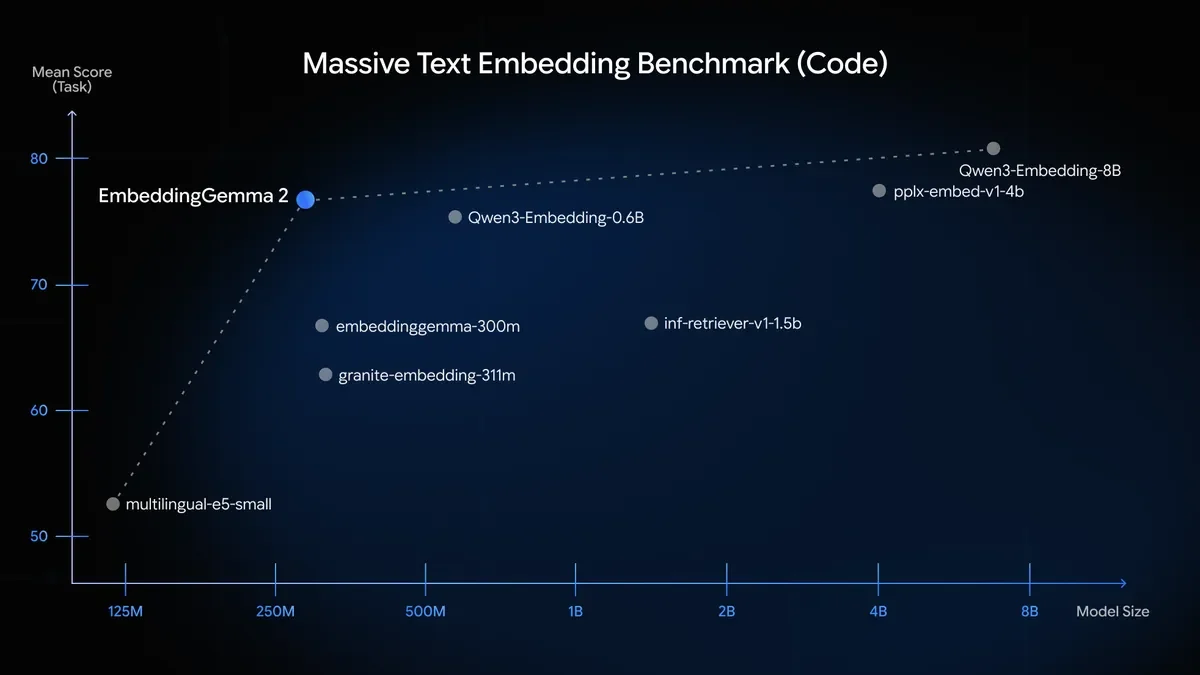
Its total is 6.73 of 10. Runs on ordinary hardware is 9: 0.74B parameters, made for on-device search. Most rated is 7.84: 503,609 Hugging Face downloads and 3,344 likes in its first five weeks. Proven quality is 6: rank 40 of 177 on MTEB Multilingual v2, read on 13 November 2026; Google reports 61.36 there, 68.46 on MTEB English v2 and 78.68 on MTEB Code. Most useful is 3.94, from 170 fine-tunes and 7 adapters.
Where this comes from
How It Works
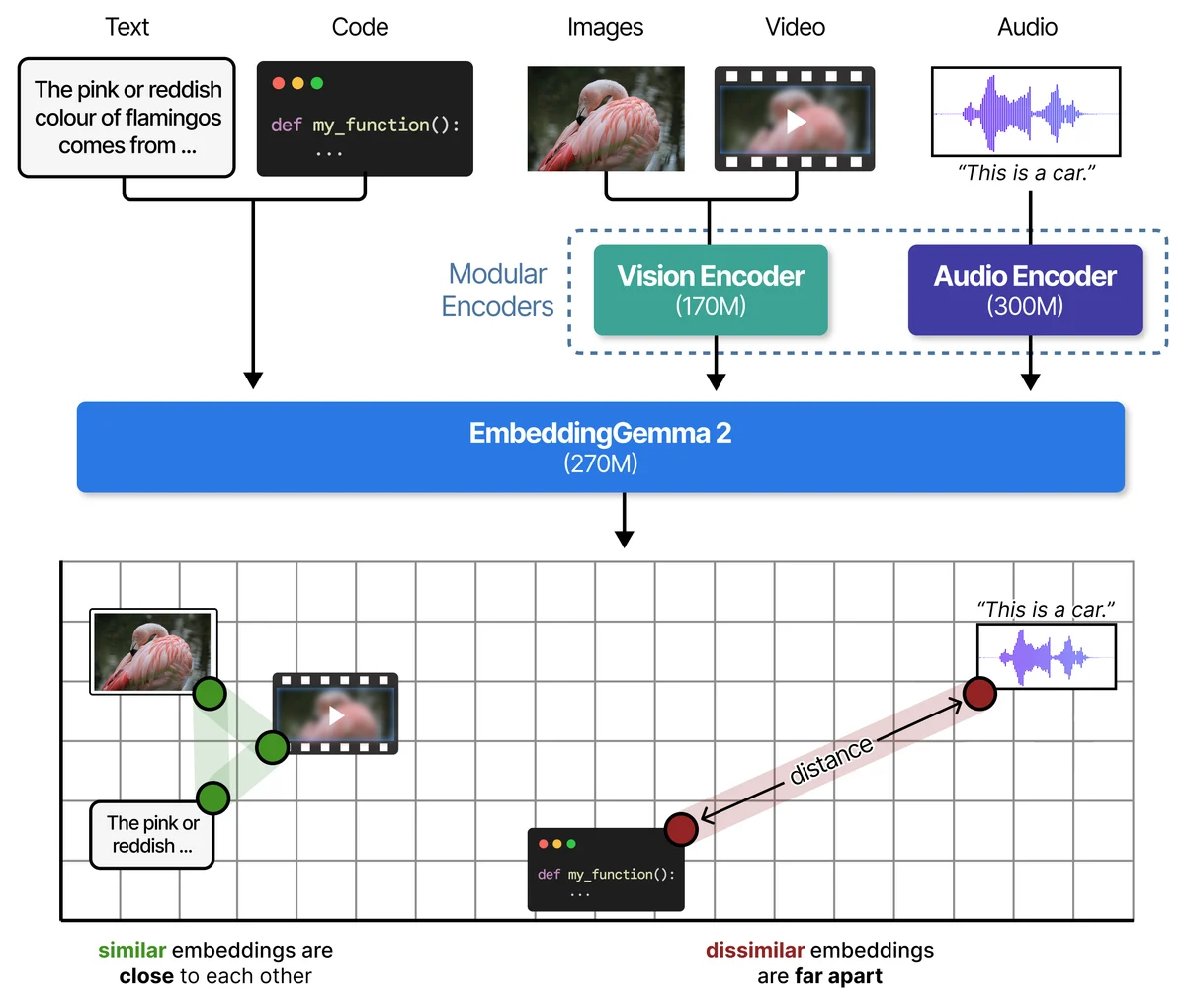
EmbeddingGemma 2: from any input to one vector
Text goes through a token embedder. Images, video frames and audio are first turned into soft tokens by their own encoders: a ViT vision encoder (280 tokens per image and 140 per video frame by default) and a Conformer audio encoder that gives 25 tokens per second. All tokens sit in one sequence, up to 8,192 tokens.
A 24-layer Transformer with bidirectional attention reads the whole sequence. The outputs are mean-pooled, projected from 512 to 768 dimensions and L2-normalised. Matryoshka training lets the first 512, 256 or 128 numbers of the vector work on their own.
The technical report describes three training stages: text pre-finetuning (about 300B tokens, mostly distillation from Gemini Embedding 2), multimodal pre-finetuning (about 2T tokens, distillation), and multimodal finetuning (about 600B tokens, contrastive loss). Checkpoints are then merged, and a final quantisation-aware stage prepares the quantised weights.
Where this comes from
Examples

Golden Gate photo against candidates: a kitchen painting image, "San Francisco", "a cute cat walking", "a friendly dog sitting in the grass"
Quoted scores: San Francisco 0.641, kitchen painting 0.585, cute cat 0.534, dog 0.509
roses-are.wav against "a person speaking English", "random static white noise", "Roses are red, violets are blue."
Quoted scores: Roses are red, violets are blue. 0.876; a person speaking English 0.679; random static white noise 0.651
Where this comes from
Screenshots
Where this comes from
How to Run It
- Hardware
- Model card: designed for phones and laptops; use bfloat16 or float32, never float16 (it gives invalid, not-a-number or degraded embeddings); audio mono 16 kHz; video 1 frame per second by default. Launch blog: about 191 MB active RAM text-only and about 567 MB full multimodal on a Pixel 11 Pro with quantisation.
- Runtimes
- sentence-transformerstransformersTransformers.jsvLLMSGLangMLXllama.cppOllamaLM StudioLiteRT (formerly TensorFlow Lite) and LiteRT-LMMediaPipe
from sentence_transformers import SentenceTransformer

model = SentenceTransformer("google/embeddinggemma-2")

query = "What causes the northern lights?"
document = "The northern lights are caused by charged particles from the sun."

query_emb = model.encode(query, prompt_name="SearchQuery")
doc_emb = model.encode(document, prompt_name="Document")
print(model.similarity(query_emb, doc_emb))
python from the official source
Where this comes from
Licence
Apache-2.0
Apache 2.0 lets anyone use, change and share the model, also commercially, and grants a patent licence. Copies must keep the licence and notices, and changed files must say they were changed. Unlike EmbeddingGemma 1, the download is not gated; the model card still asks deployments to follow the Gemma Prohibited Use Policy.
Benchmarks
MTEB Multilingual v2, Mean(Task) (score)
MTEB English v2, Mean(Task) (score)
MTEB Code (score)
MMEB v2 overall (score)
MAEB, Mean(Task) (score)
MSEB Retrieval, MRR@10 (score)
Where this comes from
Limitations
- English text shows a modest regression against EmbeddingGemma 1 (68.46 against 69.67), and zero-shot paralinguistic tasks such as speaker gender clustering are weak. (arxiv.org)
- At 128 dimensions multimodal quality drops a lot, for example MMEB v2 overall from 59.01 to 45.65; Google says 128 dimensions should be checked against your own workload (https://huggingface.co/google/embeddinggemma-2; https://mixed-news.com/en/?p=35813).
- It is a pre-trained embedding model without alignment, safety tuning or output moderation; safeguards are left to the deployer. (huggingface.co)
- Every comparison Google published on the card is against its own earlier model; MIXED News notes that every score is Google measuring Google. (mixed-news.com)
Further Reading
- EmbeddingGemma 2: Unified and Efficient Multimodal Representations Google DeepMind (arXiv), 27 Oct 2026
- EmbeddingGemma 2: an open, lightweight multimodal embedding model Google, The Keyword (Sahil Dua, Henrique Schechter Vera), 6 Oct 2026
- EmbeddingGemma 2: The Developer Guide Google Developers Blog (Maarten Grootendorst, Ian Ballantyne), 6 Oct 2026
- Google's EmbeddingGemma 2 drops the Gemma licence gate, and gains 0.21 on multilingual text MIXED News (Shane S. Ellison), 7 Oct 2026
- DeepMind Releases EmbeddingGemma 2 for Edge Search Let's Data Science, 6 Oct 2026
Sources
- google/embeddinggemma-2 , Hugging Face huggingface.co https://huggingface.co/google/embeddinggemma-2
- blog.google/innovation-and-ai/technology/developers-tools... https://blog.google/innovation-and-ai/technology/developers-tools/embeddinggemma-2
- developers.googleblog.com/en/embeddinggemma-2-the-developer-guide https://developers.googleblog.com/en/embeddinggemma-2-the-developer-guide/
- ai.google.dev/gemma/docs/embeddinggemma https://ai.google.dev/gemma/docs/embeddinggemma
- ai.google.dev/gemma/docs/embeddinggemma/multimodal-embeddin... https://ai.google.dev/gemma/docs/embeddinggemma/multimodal-embeddinggemma-with-sentence-transformers
- arxiv.org/abs/2610.37364 https://arxiv.org/abs/2610.37364
- arxiv.org/html/2610.37364 https://arxiv.org/html/2610.37364
- huggingface.co/spaces/mteb/leaderboard https://huggingface.co/spaces/mteb/leaderboard
- mixed-news.com/en/?p=35813 https://mixed-news.com/en/?p=35813
- letsdatascience.com/news/deepmind-releases-embeddinggemma-2-for-e... https://letsdatascience.com/news/deepmind-releases-embeddinggemma-2-for-edge-search-fbcc7c51
- insiderllm.com/guides/embedding-models-rag https://insiderllm.com/guides/embedding-models-rag/
To cite this page: Project AURION, AI Use-Cases Research & Innovation, "EmbeddingGemma 2", https://aurion.semai.id/top-10/google-embeddinggemma-2/, records of November 2026.