
YOLO26
YOLO26 is a family of real-time vision models from Ultralytics that find, outline and classify objects in images and video, built for teams that deploy on CPUs, edge devices and GPUs.
 UltralyticsvisionAGPL-3.0Model record
What It Is
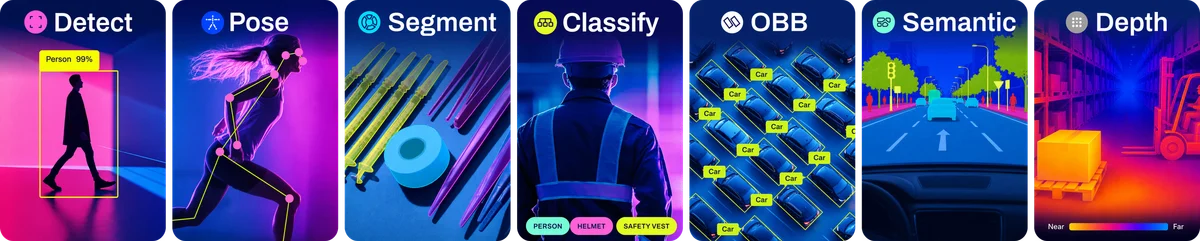
YOLO26 is the newest family of Ultralytics YOLO models. The Ultralytics docs list it as released January 2026. One model family covers object detection, instance segmentation, semantic segmentation, depth estimation, classification, pose (keypoints) and oriented boxes (OBB). Each task comes in five sizes: n, s, m, l and x.
The sizes range from YOLO26n with 2.4 million parameters to YOLO26x with 55.7 million. Pretrained weights are trained on public datasets: COCO for detection, segmentation and pose, Cityscapes for semantic segmentation, NYU Depth V2 for depth, ImageNet for classification and DOTAv1 for oriented boxes. An open-vocabulary version, YOLOE-26, can find objects named in text.
The code and weights are published under AGPL-3.0, a strong copyleft licence. Ultralytics also sells an Enterprise licence for companies that do not want to publish their own source code. The licence section below explains the difference.
Why It Is Here
26.8k downloads last month, 264 likes, 63.3k GitHub stars, 140 fine-tunes.
Its total is 7.20 of 10, the highest of the vision models considered. Proven quality is 8, the highest of the ten: on the maintainer-run Roboflow COCO leaderboard YOLO26x is rank 4 of about 60, at 56.3% mAP 50:95. Runs on ordinary hardware is 9: AURION records it on CPU servers, laptops, embedded GPUs and single datacentre GPUs. Most rated is 6.89, from 26,767 Hugging Face downloads last month, 264 likes and 63,325 GitHub stars on the ultralytics repository. Most useful is 5.56, from 140 fine-tunes and two AURION use cases: safety (PPE) and visual quality inspection.
Where this comes from
How It Works
YOLO26: From Image to Boxes Without NMS
YOLO26 removes two pieces that older YOLO models needed. First, it drops Distribution Focal Loss (DFL), which makes the detection head simpler and easier to export. Second, it can skip non-maximum suppression (NMS), the clean-up step that removes duplicate boxes after the network runs. The paper says YOLO26 uses a dual-head design for NMS-free end-to-end inference.
The two heads work like this. The default one-to-many head proposes many boxes and still uses NMS. The optional one-to-one head gives at most 300 final detections per image directly, with nms=False. The docs report speeds with this NMS-free head.
Training adds three changes. Progressive Loss (ProgLoss) moves the training weight toward the head used at inference. Small-Target-Aware Label Assignment (STAL) makes sure small objects get positive labels. MuSGD is an optimizer that mixes SGD with Muon. The paper reports up to 43% faster CPU ONNX inference for YOLO26n than YOLO11n.
Where this comes from
Examples
yolo predict model=yolo26n.pt source='https://ultralytics.com/images/bus.jpg'
An annotated copy of the image with boxes, class names and scores (the card's predict example; save=True writes the result).
Where this comes from
Screenshots
Where this comes from
How to Run It
- Hardware
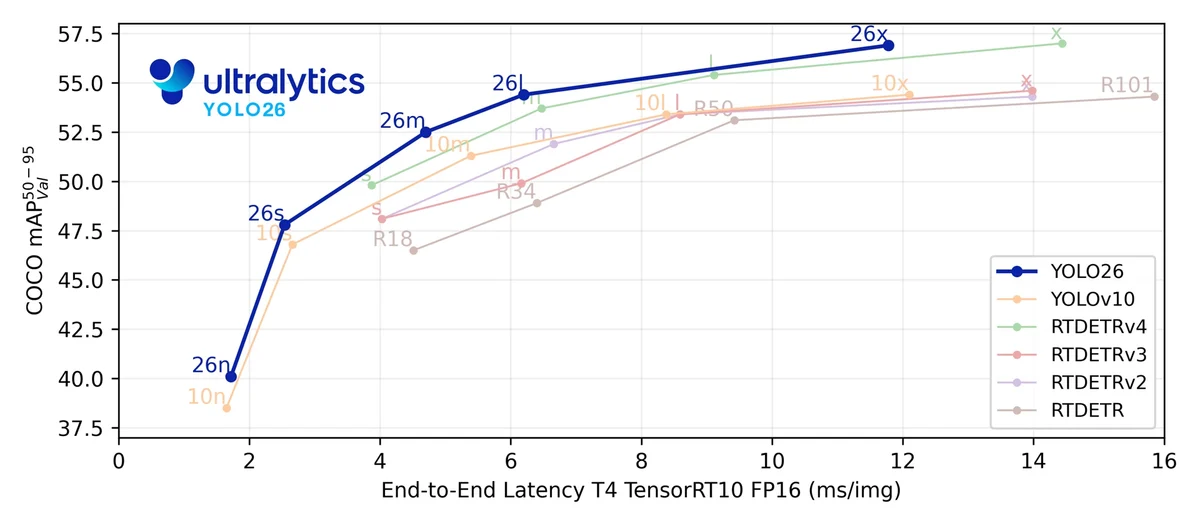
- Runs on CPU and GPU. The card reports YOLO26n at 38.9 ms per image on CPU (ONNX) and 1.7 ms on an NVIDIA T4 (TensorRT10); YOLO26x at 525.8 ms on CPU and 11.8 ms on a T4. Install needs Python 3.8 or later and PyTorch 1.8 or later.
- Runtimes
- Ultralytics Python packageONNX RuntimeTensorRTQualcomm AI HubSTM32 AI Model Zoo
from ultralytics import YOLO
model = YOLO("yolo26n.pt")
results = model("path/to/bus.jpg")
python from the official source
Where this comes from
Licence
AGPL-3.0 (with an optional Ultralytics Enterprise License)
AGPL-3.0 lets anyone use, change and ship YOLO26, including for commercial work, but only if the whole project that uses it is released as open source under AGPL-3.0. Ultralytics says compliance means publicly releasing the complete source code of the derivative work, and that all trained YOLO models fall under AGPL-3.0 by default; it also says SaaS platforms, APIs and cloud systems that use YOLO behind the scenes need the Enterprise License if the code is not published. The Enterprise License is a paid licence that lets a company build YOLO into closed products, internal tools, edge devices and services without publishing its code; price is set per request.
Benchmarks
COCO 2017 val, Roboflow leaderboard (YOLO26x) (mAP 50:95 (%))
COCO val, 640 px (vendor table, NMS head) (mAP 50:95 (%), YOLO26x)
COCO val, 640 px (vendor table, NMS-free end-to-end head) (mAP 50:95 (%), YOLO26x)
Latency on NVIDIA T4, TensorRT10 (ms per image, YOLO26n)
Latency on CPU, ONNX (ms per image, YOLO26n)
Where this comes from
Limitations
- The default predict and validate path still uses the one-to-many head with NMS; the NMS-free head has to be switched on (nms=False).
- The NMS-free head scores slightly lower than the NMS head on COCO in the vendor's own table (for example 56.9 against 57.5 for YOLO26x).
- No scale-specific P2 or P6 weights are released; those variants exist only as YAML architectures.
- The AGPL-3.0 copyleft also covers trained models and SaaS use, so closed commercial products need the paid Enterprise License.
Further Reading
- Ultralytics YOLO26: Unified Real-Time End-to-End Vision Models arXiv (Ultralytics), 2 Jun 2026
- YOLO26 Ultralytics Docs
- Ultralytics Licensing (AGPL-3.0 and Enterprise) Ultralytics
- YOLO26: Key Architectural Enhancements and Performance Benchmarking for Real-Time Object Detection arXiv (Sapkota, Cheppally, Sharda, Karkee), 29 Sep 2025
- YOLO26: An Analysis of NMS-Free End to End Framework for Real-Time Object Detection arXiv (Sudip Chakrabarty), 19 Jan 2026
- Model Leaderboard methodology Roboflow
Sources
- Ultralytics YOLO26 | Ultralytics Docs docs.ultralytics.com https://docs.ultralytics.com/models/yolo26/
- arxiv.org/abs/2606.03748 https://arxiv.org/abs/2606.03748
- ultralytics.com/license https://www.ultralytics.com/license
- huggingface.co/Ultralytics/YOLO26 https://huggingface.co/Ultralytics/YOLO26
- leaderboard.roboflow.com https://leaderboard.roboflow.com/
- leaderboard.roboflow.com/methodology https://leaderboard.roboflow.com/methodology/
- github.com/roboflow/model-leaderboard https://github.com/roboflow/model-leaderboard
- github.com/roboflow/model-leaderboard/tree/main/models/o... https://github.com/roboflow/model-leaderboard/tree/main/models/object_detection
- github.com/roboflow/model-leaderboard/tree/develop/model... https://github.com/roboflow/model-leaderboard/tree/develop/models/object_detection
- github.com/roboflow/model-leaderboard/tree/develop/model... https://github.com/roboflow/model-leaderboard/tree/develop/models/object_detection/yolov26
- github.com/roboflow/model-leaderboard/tree/develop/model... https://github.com/roboflow/model-leaderboard/tree/develop/models/object_detection/rf-detr
- github.com/roboflow/model-leaderboard/tree/develop/model... https://github.com/roboflow/model-leaderboard/tree/develop/models/object_detection/yolov11
- raw.githubusercontent.com/roboflow/model-leaderboard/develop/models/obj... https://raw.githubusercontent.com/roboflow/model-leaderboard/develop/models/object_detection/yolov26/results_yolo26x.json
- raw.githubusercontent.com/roboflow/model-leaderboard/develop/models/obj... https://raw.githubusercontent.com/roboflow/model-leaderboard/develop/models/object_detection/yolov26/results_yolo26n.json
- raw.githubusercontent.com/roboflow/model-leaderboard/develop/models/obj... https://raw.githubusercontent.com/roboflow/model-leaderboard/develop/models/object_detection/rf-detr/results_RF-DETR-XXL.json
- raw.githubusercontent.com/roboflow/model-leaderboard/develop/models/obj... https://raw.githubusercontent.com/roboflow/model-leaderboard/develop/models/object_detection/rf-detr/results_RF-DETR-L.json
- raw.githubusercontent.com/roboflow/model-leaderboard/develop/models/obj... https://raw.githubusercontent.com/roboflow/model-leaderboard/develop/models/object_detection/yolov11/results_yolo11x.json
- arxiv.org/abs/2509.25164 https://arxiv.org/abs/2509.25164
- arxiv.org/abs/2601.12882 https://arxiv.org/abs/2601.12882
To cite this page: Project AURION, AI Use-Cases Research & Innovation, "YOLO26", https://aurion.semai.id/top-10/ultralytics-yolo26/, records of November 2026.