
Chronos-2
Chronos-2 is a 120M-parameter open forecasting model from Amazon that predicts future values of one or many time series, with or without outside drivers such as prices or promotions, without training on the user's data.
 Amazontime seriesApache-2.0Model record
What It Is
Chronos-2 is a pretrained time series model for zero-shot forecasting. The model card calls it a 120M-parameter, encoder-only model. It was released on 20 October 2025 under Apache-2.0, with a smaller 28M version, Chronos-2-small.
Earlier Amazon models, Chronos and Chronos-Bolt, forecast one series at a time. Chronos-2 handles single series, several related series together, and series with covariates in one model. It accepts past-only covariates, known future covariates such as holidays or promotions, and categorical covariates. It reads up to 8,192 past steps and forecasts up to 1,024 steps ahead, as quantiles.
It can run locally through the chronos-forecasting Python package, or on AWS through AutoGluon-Cloud and SageMaker JumpStart.
Why It Is Here
8.1M downloads last month, 575 likes, 6.3k GitHub stars, 19 fine-tunes.
Its total is 6.02 of 10. Most rated is 7.52: 8,097,695 Hugging Face downloads last month, 575 likes and 6,293 GitHub stars, read on 13 November 2026. Proven quality is 6: on the GIFT-Eval leaderboard run by Salesforce it scores CRPS 0.485 and MASE 0.698 (both scaled so Seasonal Naive equals 1; lower is better), rank 75 of 166 by CRPS on 13 November 2026, or 34 of 109 without agentic and test-leak entries. GIFT-Eval lists it as pretrained, partly on its own pretraining split. Most useful is 4.77, from 19 fine-tunes, 30 adapters and two AURION use cases: industrial forecasting and demand forecasting. Runs on ordinary hardware is 5: at 0.12B parameters it is small, but no runtime in Harness lists it yet.
Where this comes from
How It Works
How Chronos-2 makes a forecast
Chronos-2 is an encoder-only transformer that closely follows the T5 encoder. Values are first scaled with standardisation and a sinh-1 transform. A time index and a mask are added, and each series is cut into non-overlapping patches. A residual network turns each patch into an embedding.
Each transformer block alternates two kinds of attention. Time attention looks across patches inside one series. Group attention looks across all series in the same group at the same patch position. Group attention is how the model learns in context from related series and covariates, for example using CPU load to inform a memory forecast, or a promotion schedule to inform demand.
A quantile head outputs 21 quantiles from 0.01 to 0.99 for several future patches in one forward pass. Training used real datasets from the Chronos and GIFT-Eval pretraining corpora plus synthetic data. Because multivariate training data is scarce, the team built synthetic multivariate series by adding correlations and lead-lag links to series from univariate generators. Training ran first with a 2,048-step context, then with an 8,192-step context.
Where this comes from
Examples
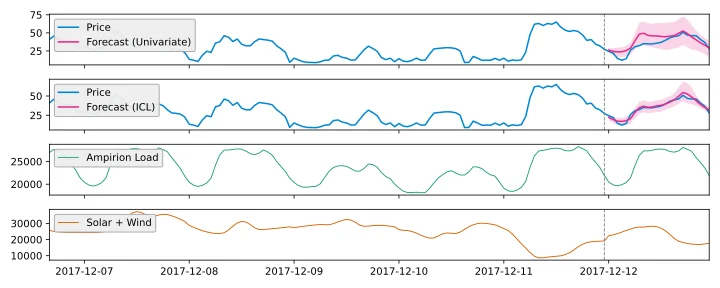
Electricity price history plus load and solar-plus-wind covariates
Price forecast; with in-context learning the model uses the covariates for a more accurate forecast
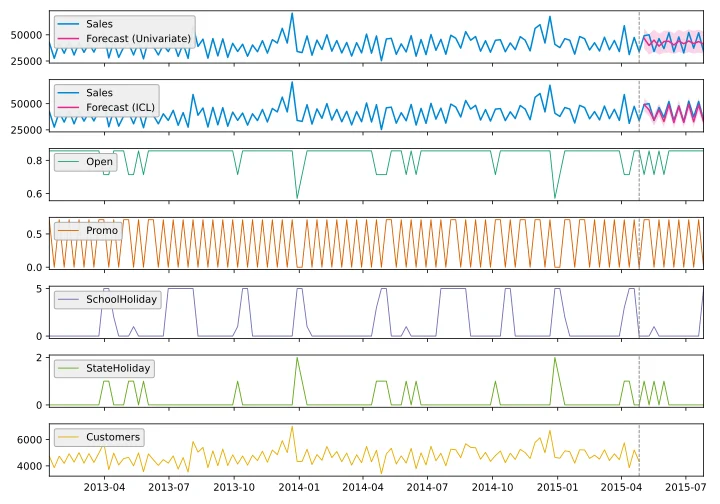
Weekly store sales plus promotion and holiday covariates
Sales forecast that captures promotion and holiday effects in in-context mode
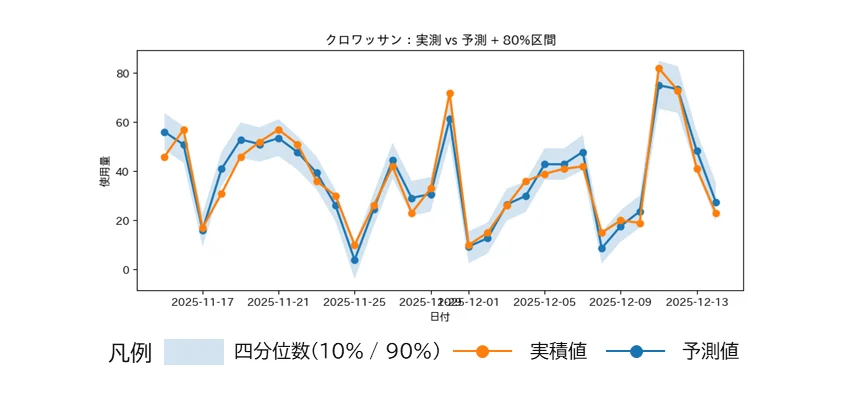
About 3 years of daily use for croissants, butter rolls and boiled eggs, with previous-night guest count, breakfast tickets issued, and lag-1 and lag-7 use as covariates; 30-day horizon
Final model: MAPE about 20.3 percent, MAE about 5.05, 80 percent interval coverage about 82.2 percent (baseline without covariates: MAPE about 56.6 percent)
context_df from https://autogluon.s3.amazonaws.com/datasets/timeseries/electricity_price/train.parquet and future covariates from the matching test.parquet
pred_df with forecasts for prediction_length=24 at quantile_levels=[0.1, 0.5, 0.9] (quoted parameters)
Where this comes from
How to Run It
- Hardware
- 120M parameters (28M for Chronos-2-small). Runs on GPU or CPU. The model card says over 300 forecasts per second on a single A10G GPU; the report measured this with 1,024 series, context 2,048 and horizon 64. The Canon IT Solutions case ran it on CPU (device_map="cpu") in a SageMaker notebook. AutoGluon-Cloud lists ml.c6i.2xlarge as the cheapest CPU option and ml.g5.xlarge as the default real-time GPU instance.
- Runtimes
- chronos-forecasting Python packageAutoGluon-CloudAmazon SageMaker JumpStart
from autogluon.cloud import TimeSeriesFoundationModel

model = TimeSeriesFoundationModel(model_name="chronos-2")

# Batch prediction
forecast_df = model.predict(df, prediction_length=24)
python from the official source
Where this comes from
Licence
Apache-2.0
Apache-2.0 lets anyone use, copy, change and share the model and code at no charge, including commercially, and gives a patent licence. Anyone who shares it must pass on a copy of the licence, mark files they changed, keep the existing notices, and include any NOTICE file.
Benchmarks
GIFT-Eval (CRPS, geometric mean scaled to Seasonal Naive) (CRPS, lower is better)
GIFT-Eval (MASE, geometric mean scaled to Seasonal Naive) (MASE, lower is better)
fev-bench (average win rate, SQL) (%)
fev-bench (skill score, SQL) (%)
Chronos Benchmark II (skill score, WQL) (%)
Where this comes from
Limitations
- Covariates must be numeric or categorical; text and other modalities are not supported (technical report, future work).
- Static, time-invariant covariates are not supported; an independent reviewer suggests grouping series that share static attributes instead (AI Horizon Forecast).
- Input must be a regular time series with no missing dates per item, or it may not be read correctly and can raise errors; the forecast starts from each item's last date (AWS Japan and Canon IT Solutions case study).
- It was trained partly on the GIFT-Eval pretraining split, so the GIFT-Eval leaderboard lists it as pretrained rather than zero-shot (leaderboard update log, 2025-08-25, and model card training data).
Further Reading
- Chronos-2: From Univariate to Universal Forecasting arXiv (Amazon Web Services), 17 Oct 2025
- Introducing Chronos-2: From univariate to universal forecasting Amazon Science blog, 20 Oct 2025
- Chronos-2: Multivariate Zero-Shot Forecasting with External Covariates AI Horizon Forecast (Nikos Kafritsas), 14 Nov 2025
- Reducing hotel food loss with Canon IT Solutions: predicting optimal serving quantities with the time series foundation model Chronos-2 (title translated from Japanese) AWS Japan blog (Canon IT Solutions and AWS Japan), 29 Jun 2026
- Run Pretrained Foundation Models on Amazon SageMaker AutoGluon-Cloud documentation
Sources
- amazon/chronos-2 , Hugging Face huggingface.co https://huggingface.co/amazon/chronos-2
- github.com/amazon-science/chronos-forecasting https://github.com/amazon-science/chronos-forecasting
- github.com/amazon-science/chronos-forecasting/blob/main/... https://github.com/amazon-science/chronos-forecasting/blob/main/LICENSE
- Introducing Chronos-2: From univariate to universal forecasting amazon.science https://www.amazon.science/blog/introducing-chronos-2-from-univariate-to-universal-forecasting
- arxiv.org/html/2510.15821 https://arxiv.org/html/2510.15821
- arxiv.org/html/2510.15821v1 https://arxiv.org/html/2510.15821v1
- GIFT Eval - a Hugging Face Space by Salesforce huggingface.co https://huggingface.co/spaces/Salesforce/GIFT-Eval
- salesforce-gift-eval.hf.space https://salesforce-gift-eval.hf.space/
- aihorizonforecast.substack.com/p/chronos-2-multivariate-zero-shot https://aihorizonforecast.substack.com/p/chronos-2-multivariate-zero-shot
- auto.gluon.ai/cloud/dev/tutorials/foundation-model-timeseri... https://auto.gluon.ai/cloud/dev/tutorials/foundation-model-timeseries.html
- aws.amazon.com/jp/blogs/news/sustainability-case-study-canon... https://aws.amazon.com/jp/blogs/news/sustainability-case-study-canon-its-chronos-2-foodloss-management/
To cite this page: Project AURION, AI Use-Cases Research & Innovation, "Chronos-2", https://aurion.semai.id/top-10/amazon-chronos-2/, records of November 2026.