
DeepSeek-OCR
DeepSeek-OCR is a 3B-parameter open model from DeepSeek that reads document images and turns them into text or Markdown using very few vision tokens, for teams that convert large volumes of pages.
 DeepSeekOCR and documentMITModel record
What It Is
DeepSeek-OCR reads an image of a page and writes out its text. With a grounding prompt it can convert a whole document to Markdown, and it can also parse figures, describe images and locate a named item. DeepSeek released it on 20 October 2025 under the title Contexts Optical Compression.
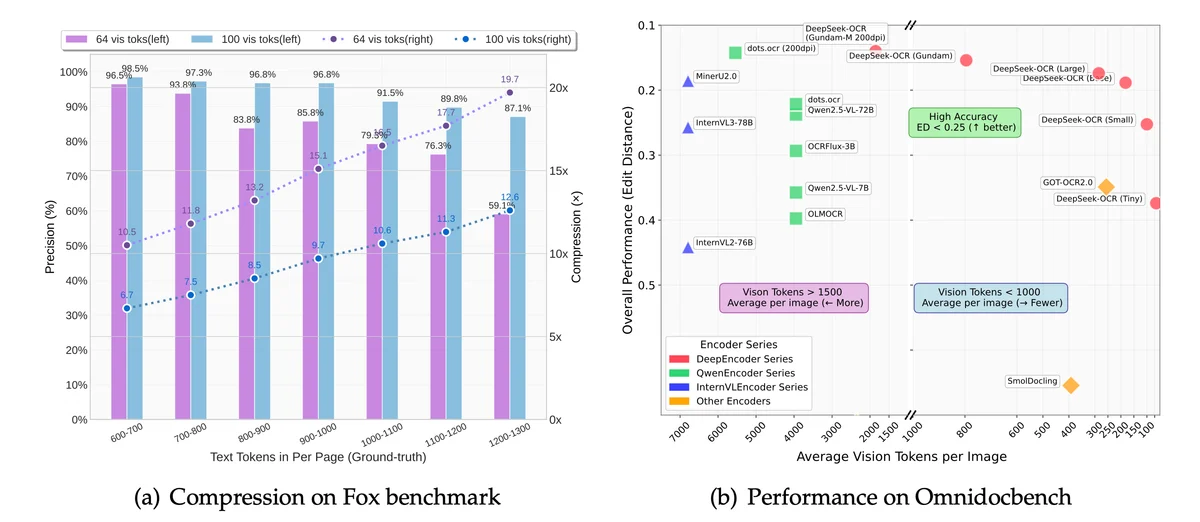
The research question behind it is how much text a few vision tokens can carry. The paper reports about 97% decoding precision when the text is compressed up to 10 times into vision tokens, and about 60% at 20 times. In practice this means a page can be fed to a language model as a small number of image tokens.
The model has about 3 billion parameters in BF16 and is released under the MIT licence. DeepSeek says one A100-40G GPU can process more than 200,000 pages a day. A follow-up, DeepSeek-OCR 2, was announced on 27 January 2026 in a separate repository.
Why It Is Here
1.9M downloads last month, 3.5k likes, 24.1k GitHub stars, 132 fine-tunes.
Its total is 5.87 of 10. Most rated is its strongest score, 8.29, the highest of the OCR models: 1,918,802 Hugging Face downloads last month, 3,462 likes and 24,147 GitHub stars. Runs on ordinary hardware is 7, at 3.34B parameters. Proven quality is only 3: its one comparable result is reported in a paper, not on an independent leaderboard, and that result, 73.99 overall on Real5-OmniDocBench in the PaddleOCR-VL-1.6 paper, is well below newer document parsers. Most useful is 3.86, from 132 fine-tunes and 27 adapters; no AURION use case links to it yet.
Where this comes from
How It Works
DeepSeek-OCR: From Page Image to Markdown
The model has two parts. The DeepEncoder, about 380 million parameters, turns the image into a few vision tokens. A DeepSeek-3B-MoE decoder, with 570 million parameters active per token, turns those tokens back into text.
Inside the DeepEncoder, an 80M SAM-base encoder first looks at small patches with local attention. A 16 times convolutional compressor then shrinks the tokens: a 1024 by 1024 image gives 4096 patch tokens, cut to 256. A 300M CLIP-large encoder then applies global attention to the short sequence. This keeps memory low on large images.
Users pick a resolution mode: Tiny (512 px, 64 tokens), Small (640 px, 100 tokens), Base (1024 px, 256 tokens), Large (1280 px, 400 tokens) or Gundam, which tiles the page into 640 px crops plus one 1024 px global view. Training data was 70% OCR, 20% general vision and 10% text only, including 30 million PDF pages in about 100 languages.
Where this comes from
Examples
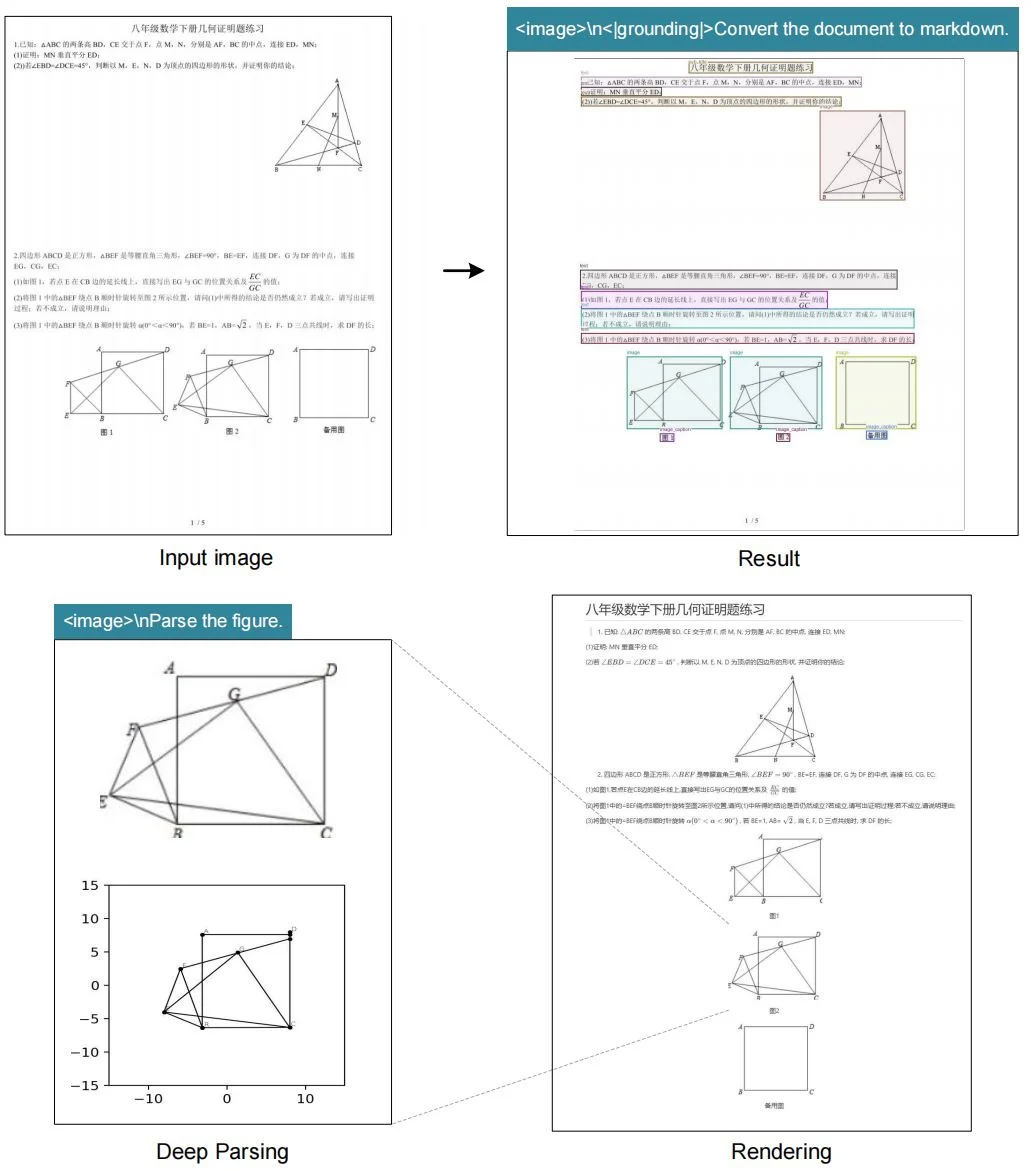
<image>\n<|grounding|>Convert the document to markdown. | <image>\nFree OCR. | <image>\nParse the figure. | <image>\nLocate <|ref|>xxxx<|/ref|> in the image.
Markdown with layout grounding, plain text without layout, a parsed figure, or the location of the named item.
Where this comes from
How to Run It
- Hardware
- Tested on NVIDIA GPUs with CUDA 11.8 and torch 2.6.0, Python 3.12.9. The README reports about 2,500 tokens per second for PDF inference on one A100-40G; the paper reports more than 200,000 pages per day on one A100-40G. Needs flash-attn 2.7.3.
- Runtimes
- transformersvLLMoMLX
from transformers import AutoModel, AutoTokenizer
import torch
import os
os.environ["CUDA_VISIBLE_DEVICES"] = '0'
model_name = 'deepseek-ai/DeepSeek-OCR'

tokenizer = AutoTokenizer.from_pretrained(model_name, trust_remote_code=True)
model = AutoModel.from_pretrained(model_name, _attn_implementation='flash_attention_2', trust_remote_code=True, use_safetensors=True)
model = model.eval().cuda().to(torch.bfloat16)

# prompt = "<image>\nFree OCR. "
prompt = "<image>\n<|grounding|>Convert the document to markdown. "
image_file = 'your_image.jpg'
output_path = 'your/output/dir'

res = model.infer(tokenizer, prompt=prompt, image_file=image_file, output_path = output_path, base_size = 1024, image_size = 640, crop_mode=True, save_results = True, test_compress = True)
python from the official source
Where this comes from
Licence
MIT
MIT lets anyone use, copy, change, sell and build the model into closed products. The only condition is to keep the copyright notice and licence text. There is no warranty.
Benchmarks
OmniDocBench (English), overall edit distance, Gundam mode (795 tokens) (edit distance (lower is better))
OmniDocBench (English), overall edit distance, by DeepSeek-OCR mode (edit distance (lower is better), Small mode, 100 tokens)
Fox, 600 to 700 text tokens, 64 vision tokens (10.5x compression) (decoding precision (%))
Real5-OmniDocBench, overall (score (higher is better))
Where this comes from
Limitations
- The paper says precision falls beyond 10 times compression, and long newspaper pages need the Gundam modes; the model has no SFT stage, so it is not a chatbot.
- An independent study found performance drops from about 90% to 20% when sentences and words are scrambled, so much of its accuracy leans on language priors; it also reports collapse around 10,000 text tokens.
- Pulse AI (which sells a competing product) found shifting bounding boxes, different outputs across runs, a dropped table column and some invented text on hard documents.
- A DataCamp tutorial found chart and table output is verbose HTML that needs clean-up, some SMILES strings were invalid, and multilingual pages were slower.
Further Reading
- DeepSeek-OCR: Contexts Optical Compression arXiv (Haoran Wei, Yaofeng Sun, Yukun Li), 2025
- DeepSeek-OCR README GitHub (DeepSeek), 20 Oct 2025
- Visual Merit or Linguistic Crutch? A Close Look at DeepSeek-OCR arXiv (Liang et al.), 7 Jan 2026
- DeepSeek-OCR: A Hands-On Guide With 7 Practical Examples DataCamp (Aashi Dutt), 2 Nov 2025
- Putting DeepSeek-OCR to the Test Pulse AI (Sid and Ritvik), 21 Jan 2026
Sources
- huggingface.co/deepseek-ai/DeepSeek-OCR https://huggingface.co/deepseek-ai/DeepSeek-OCR
- github.com/deepseek-ai/DeepSeek-OCR https://github.com/deepseek-ai/DeepSeek-OCR
- arxiv.org/html/2510.18234 https://arxiv.org/html/2510.18234
- arxiv.org/abs/2606.03264 https://arxiv.org/abs/2606.03264
- arxiv.org/html/2606.03264 https://arxiv.org/html/2606.03264
- arxiv.org/abs/2601.03714 https://arxiv.org/abs/2601.03714
- runpulse.com/blog/putting-deepseek-ocr-to-the-test https://runpulse.com/blog/putting-deepseek-ocr-to-the-test
- datacamp.com/tutorial/deepseek-ocr-hands-on-guide https://www.datacamp.com/tutorial/deepseek-ocr-hands-on-guide
To cite this page: Project AURION, AI Use-Cases Research & Innovation, "DeepSeek-OCR", https://aurion.semai.id/top-10/deepseek-deepseek-ocr/, records of November 2026.