
TimesFM 2.5
TimesFM 2.5 is a 200M-parameter open forecasting model from Google Research that predicts the next values of a time series, with quantile ranges, without training on the user's data.
 Googletime seriesApache-2.0Model record
What It Is
TimesFM is Google Research's pretrained foundation model for time series forecasting. Version 2.5 was released on 15 September 2025. The checkpoint google/timesfm-2.5-200m-pytorch is under Apache-2.0.
Compared with TimesFM 2.0, version 2.5 has 200M parameters instead of 500M, and its context grows from 2,048 to 16k points. An optional 30M quantile head gives continuous quantile forecasts up to a 1k horizon, and the frequency indicator is removed. Covariate support through XReg returned for 2.5 on 29 October 2025.
The checkpoint was pretrained on GiftEvalPretrain, Wikimedia pageviews, Google Trends top queries and synthetic data. Google says the open version is not an officially supported Google product. In August 2026 Google released TimesFM 3.0, whose weights are under a non-commercial licence; the 2.5 weights stay Apache-2.0.
Why It Is Here
1.8M downloads last month, 282 likes, 35.4k GitHub stars, 2 fine-tunes.
Its total is 5.53 of 10. Most rated is 7.48, driven by 35,435 GitHub stars and 1,755,012 Hugging Face downloads last month, read on 13 November 2026. Proven quality is 6: on the GIFT-Eval leaderboard run by Salesforce it scores CRPS 0.49 and MASE 0.705 (lower is better), rank 86 of 166 by CRPS on 13 November 2026, or 44 of 109 without agentic and test-leak entries; GIFT-Eval lists it as zero-shot. Runs on ordinary hardware is 5: 0.23B parameters, but no runtime in Harness lists it yet. Most useful is 2.85, from 2 fine-tunes, 1 adapter and two AURION use cases: industrial forecasting and demand forecasting.
Where this comes from
How It Works
How TimesFM 2.5 makes a forecast
TimesFM is a decoder-only transformer, like a language model, but its tokens are patches of time points. A small residual network (MLP) turns each input patch into a token, and positional encodings are added. Stacked causal attention layers then read the tokens and cannot look ahead.
Each output token can cover more future points than an input patch. In Google's blog example, input patches are 32 points and output patches 128 points, so forecasting 256 points takes 2 steps instead of 8. Google reports that fewer steps mean fewer chances for errors to build up over long horizons. The original model was pretrained on about 100 billion real-world time points, mostly Google Trends and Wikipedia pageviews, plus synthetic data.
Version 2.5 keeps this design with 200M parameters, a context of up to 16k points and an optional 30M continuous quantile head. The model card's example config sets max_context=1024 and max_horizon=256, and turns on input normalisation, flip invariance, positive-value inference and quantile-crossing fixes. The output is a point forecast plus a mean and the 10th to 90th quantiles.
Where this comes from
Examples
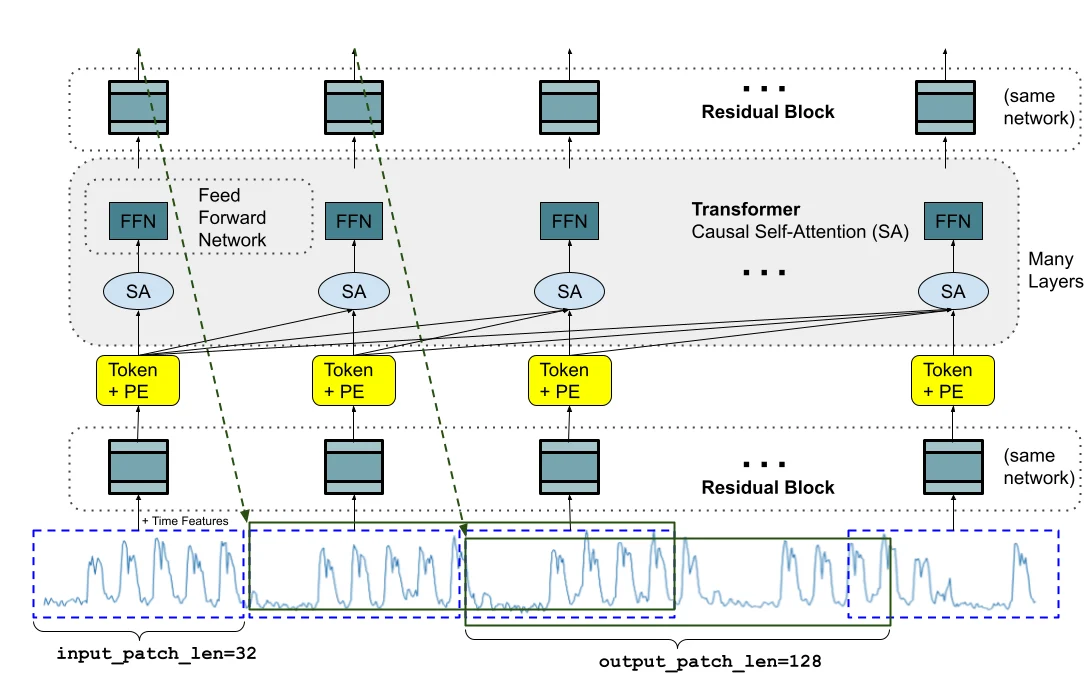
Patched time series
Forecast output patches
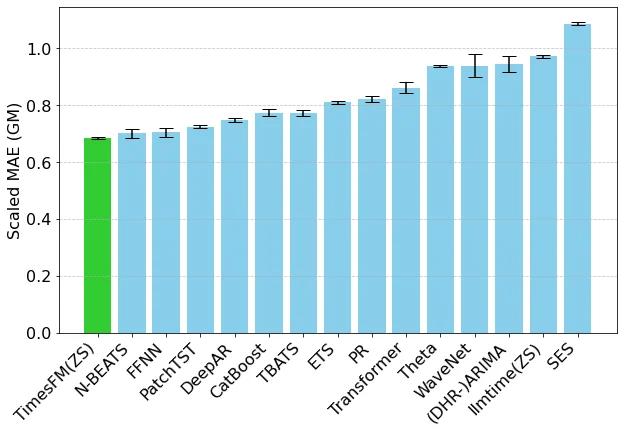
Monash Forecasting Archive datasets
Scaled MAE chart, lower is better
inputs=[np.linspace(0, 1, 100), np.sin(np.linspace(0, 20, 67))], horizon=12 (quoted)
point_forecast.shape # (2, 12); quantile_forecast.shape # (2, 12, 10): mean, then 10th to 90th quantiles. (quoted)
Where this comes from
How to Run It
- Hardware
- 200M parameters (231.3M, counted from the Hugging Face weights). The model card names no hardware; its example uses torch_compile=True and the repo's PyTorch examples use device="cuda".
- Runtimes
- timesfm Python packageGoogle Cloud BigQuery ML
import numpy as np
import timesfm
model = timesfm.TimesFM_2p5_200M_torch.from_pretrained("google/timesfm-2.5-200m-pytorch", torch_compile=True)

model.compile(
    timesfm.ForecastConfig(
        max_context=1024,
        max_horizon=256,
        normalize_inputs=True,
        use_continuous_quantile_head=True,
        force_flip_invariance=True,
        infer_is_positive=True,
        fix_quantile_crossing=True,
    )
)
point_forecast, quantile_forecast = model.forecast(
    horizon=12,
    inputs=[
        np.linspace(0, 1, 100),
        np.sin(np.linspace(0, 20, 67)),
    ],  # Two dummy inputs
)
point_forecast.shape  # (2, 12)
quantile_forecast.shape  # (2, 12, 10): mean, then 10th to 90th quantiles.
python from the official source
Where this comes from
Licence
Apache-2.0
Apache-2.0 lets anyone use, copy, change and share the model and code at no charge, including commercially, and gives a patent licence. Anyone who shares it must pass on the licence, mark changed files and keep existing notices. This applies to weights up to 2.5; TimesFM 3.0 weights are under a separate non-commercial licence.
Benchmarks
GIFT-Eval (CRPS, geometric mean scaled to Seasonal Naive) (CRPS, lower is better)
GIFT-Eval (MASE, geometric mean scaled to Seasonal Naive) (MASE, lower is better)
fev-bench (average win rate, SQL) (%)
fev-bench (skill score, SQL) (%)
GIFT-Eval (skill score, MASE) (%)
Chronos Benchmark II (skill score, WQL) (%)
Where this comes from
Limitations
- The open checkpoint is not an officially supported Google product; Google points to TimesFM in BigQuery for official support (model card and README).
- Long horizons are built by stitching several output patches, and the README advises checking them separately; it also says contexts longer than 15,360 points are cut to the most recent points (README, stated in the TimesFM 3.0 section).
- Covariates: an independent tutorial dated 30 October 2025 says TimesFM 2.5 did not support external covariates and that its API returns no in-sample predictions, which blocks one XReg mode (AI Horizon Forecast); the README says XReg support returned for 2.5 on 29 October 2025.
- The model card publishes no benchmark numbers of its own; the GIFT-Eval and Chronos-2 report figures come from other parties.
Further Reading
- A decoder-only foundation model for time-series forecasting arXiv (Google Research), ICML 2024, 14 Oct 2023
- A decoder-only foundation model for time-series forecasting Google Research blog
- TimesFM-2.5 + External Covariates: A Practical Retail Forecasting Tutorial AI Horizon Forecast (Nikos Kafritsas), 30 Oct 2025
- TimesFM 2.5: Google's Open-Source Time Series Foundation Model The Menon Lab (Prahlad G. Menon), 21 Feb 2026
- Chronos-2: From Univariate to Universal Forecasting (includes TimesFM-2.5 comparisons) arXiv (Amazon Web Services), 17 Oct 2025
Sources
- google/timesfm-2.5-200m-pytorch , Hugging Face huggingface.co https://huggingface.co/google/timesfm-2.5-200m-pytorch
- github.com/google-research/timesfm https://github.com/google-research/timesfm
- github.com/google-research/timesfm/blob/master/LICENSE https://github.com/google-research/timesfm/blob/master/LICENSE
- research.google/blog/a-decoder-only-foundation-model-for-time... https://research.google/blog/a-decoder-only-foundation-model-for-time-series-forecasting/
- arxiv.org/abs/2310.10688 https://arxiv.org/abs/2310.10688
- GIFT Eval - a Hugging Face Space by Salesforce huggingface.co https://huggingface.co/spaces/Salesforce/GIFT-Eval
- salesforce-gift-eval.hf.space https://salesforce-gift-eval.hf.space/
- arxiv.org/html/2510.15821 https://arxiv.org/html/2510.15821
- aihorizonforecast.substack.com/p/timesfm-25-external-covariates-a https://aihorizonforecast.substack.com/p/timesfm-25-external-covariates-a
- themenonlab.blog/blog/timesfm-google-time-series-foundation-mo... https://themenonlab.blog/blog/timesfm-google-time-series-foundation-model
To cite this page: Project AURION, AI Use-Cases Research & Innovation, "TimesFM 2.5", https://aurion.semai.id/top-10/google-timesfm-2-5/, records of November 2026.