
GLM-OCR
GLM-OCR is a small open model from Z.ai that turns document images and PDFs into Markdown, HTML tables, LaTeX formulas and JSON fields, for teams that need document parsing they can run themselves.
 Z.ai (Zhipu)OCR and documentMITModel record
What It Is
GLM-OCR is a multimodal OCR model for complex document understanding. The technical report gives it 0.9B parameters: a 0.4B CogViT vision encoder and a 0.5B GLM language decoder. The weights are released under the MIT licence on Hugging Face and ModelScope, with an SDK and inference toolchain on GitHub.
It reads printed text, handwriting, formulas, tables and forms. For whole documents it first finds the layout with PP-DocLayout-V3, then reads each region in parallel and merges the results into Markdown and JSON. For key information extraction it reads the whole page against a JSON schema given in the prompt.
Z.ai also offers it as a paid API. The API guide lists Chinese, English, French, Spanish, Russian, German, Japanese and Korean among its languages, and PDF, JPG and PNG as inputs, with limits of 10 MB per image, 50 MB per PDF and 100 pages per request.
Why It Is Here
1.8M downloads last month, 2.2k likes, 7.6k GitHub stars, 38 fine-tunes.
Its total is 5.69 of 10. Runs on ordinary hardware is 8: it is small, 1.33B parameters counted from the Hugging Face weights. Most rated is 7.8: 1,793,299 Hugging Face downloads last month, 2,215 likes and 7,592 GitHub stars, read on 13 November 2026. Proven quality is 3: its best results, 95.22 on OmniDocBench v1.6 and 90.32 on Real5-OmniDocBench, are reported by the vendor in a paper, with no independent leaderboard result. Most useful is 3.02, from 38 fine-tunes and 14 adapters; no AURION use case links to it yet.
Where this comes from
How It Works
How GLM-OCR parses a document
The model follows the GLM-V encoder-decoder design. A CogViT vision encoder of about 0.4B parameters reads the image. A light connector projects the visual features into the language model as prefix tokens, and a GLM decoder of about 0.5B parameters writes the output as Markdown or JSON, one step at a time.
To decode faster, the model is trained with Multi-Token Prediction. The report says it is trained to predict 10 tokens per step with shared-parameter heads, and at inference it averages 5.2 tokens per step, for roughly 50 percent higher throughput. Training runs in four stages: vision encoder pretraining, joint pretraining, pretraining and fine-tuning with MTP, and reinforcement learning with GRPO. The rewards are task-specific: edit distance for text, CDM for formulas, TEDS for tables and field-level F1 for key information extraction.
For document parsing, PP-DocLayout-V3 splits the page into regions such as paragraphs, tables and formulas. Each region is cropped and recognised on its own, in parallel. A merge step restores reading order and writes Markdown and JSON. For key information extraction there is no layout step: the whole page goes in with a task prompt.
Where this comes from
Examples
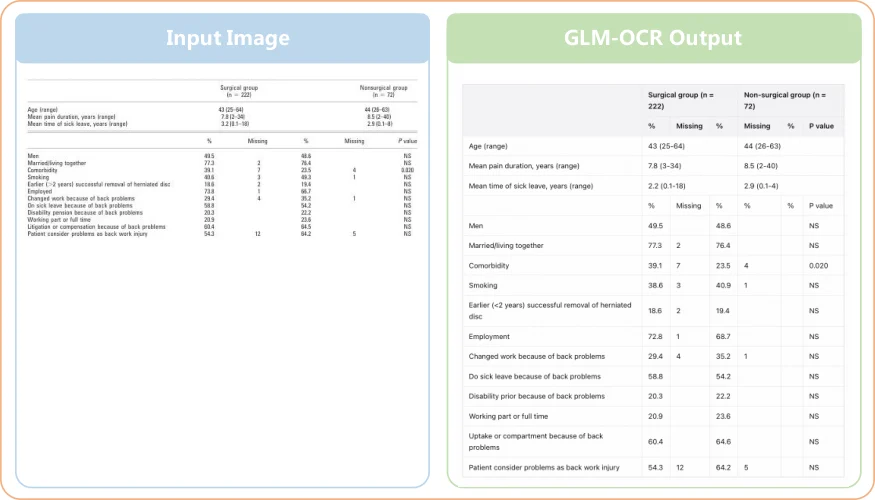
Image of a clinical summary table with merged cells
The table rebuilt as structured output
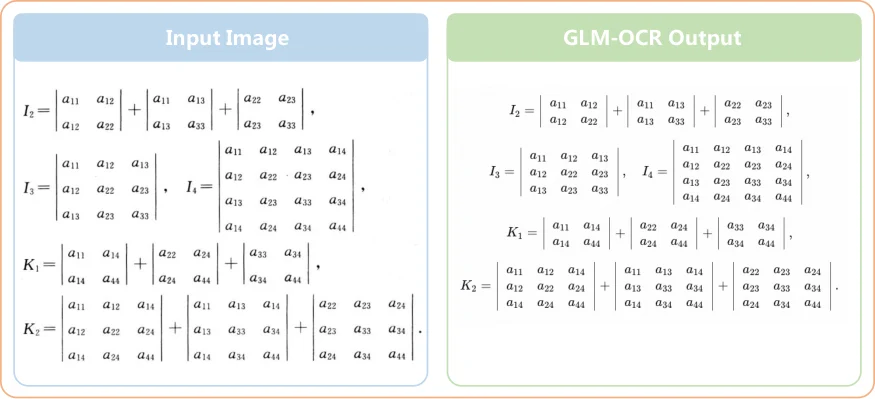
Image of dense mathematical equations
LaTeX source of the equations
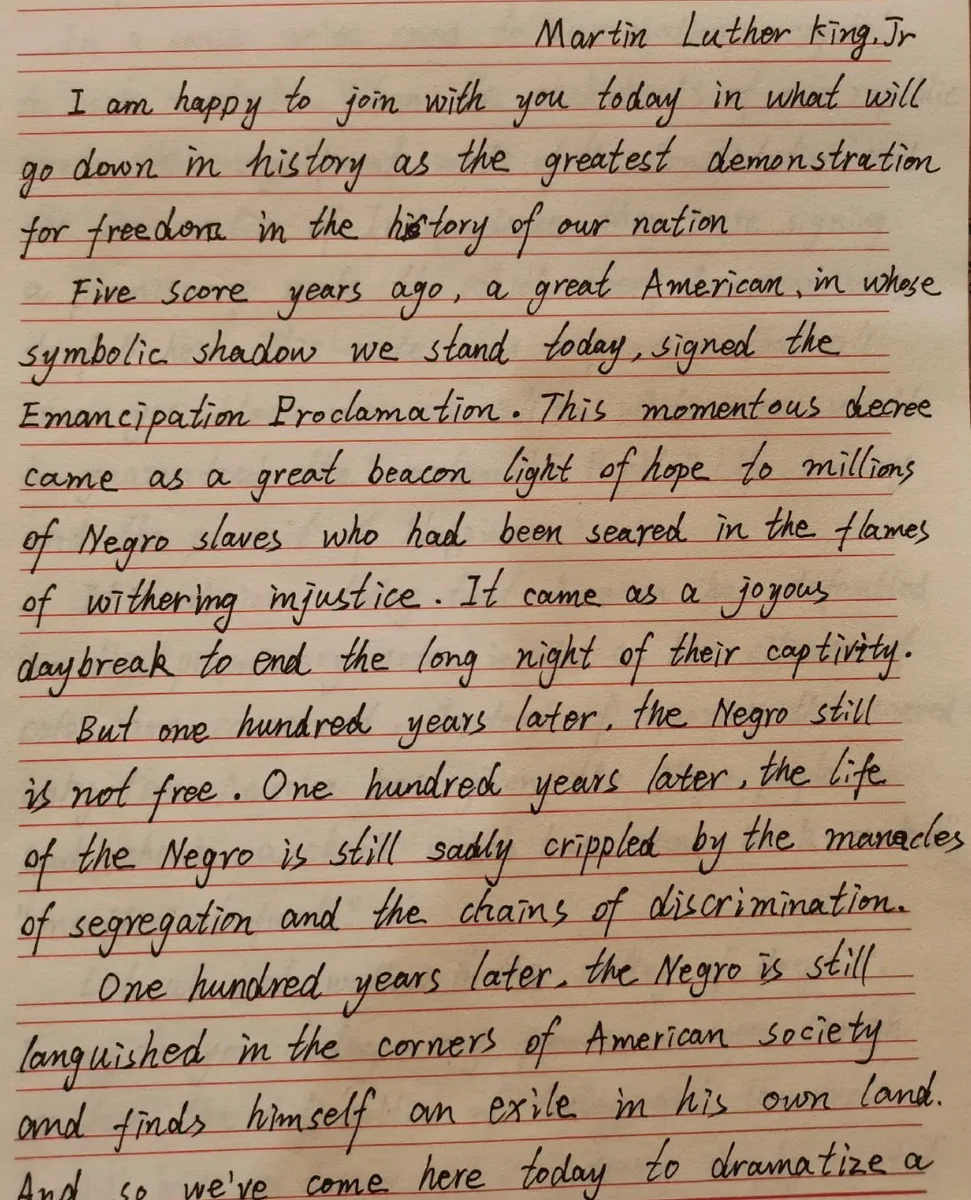
Handwritten page (image)
Recognised text, shown in the paired output image
Where this comes from
Screenshots
Where this comes from
How to Run It
- Hardware
- The model card and README give no minimum GPU. The README says self-hosting needs a GPU, while the Zhipu MaaS API needs no GPU. Large images and PDFs may need tuning of --max-model-len and --gpu-memory-utilization in vLLM, or --context-len and --mem-fraction-static in SGLang. Speed on the card: 1.86 PDF pages per second and 0.67 images per second, single replica and single concurrency; the hardware is not named.
- Runtimes
- vLLMSGLangOllamatransformersmlx-vlmglmocr SDK
from transformers import pipeline

pipe = pipeline("image-to-text", model="zai-org/GLM-OCR")
messages = [{"role": "user", "content": [
    {"type": "image", "url": "https://huggingface.co/datasets/huggingface/documentation-images/resolve/main/p-blog/candy.JPG"},
    {"type": "text", "text": "What animal is on the candy?"}]}]
print(pipe(text=messages))
python from the official source
Where this comes from
Licence
MIT (model weights); Apache-2.0 (code)
The weights are under the MIT licence, which lets anyone use, change, publish and sell the model, including in commercial products, as long as the copyright and licence notice are kept; it comes with no warranty. The SDK code is under Apache-2.0, and the bundled PP-DocLayoutV3 layout model is also Apache-2.0, so users must follow both licences.
Benchmarks
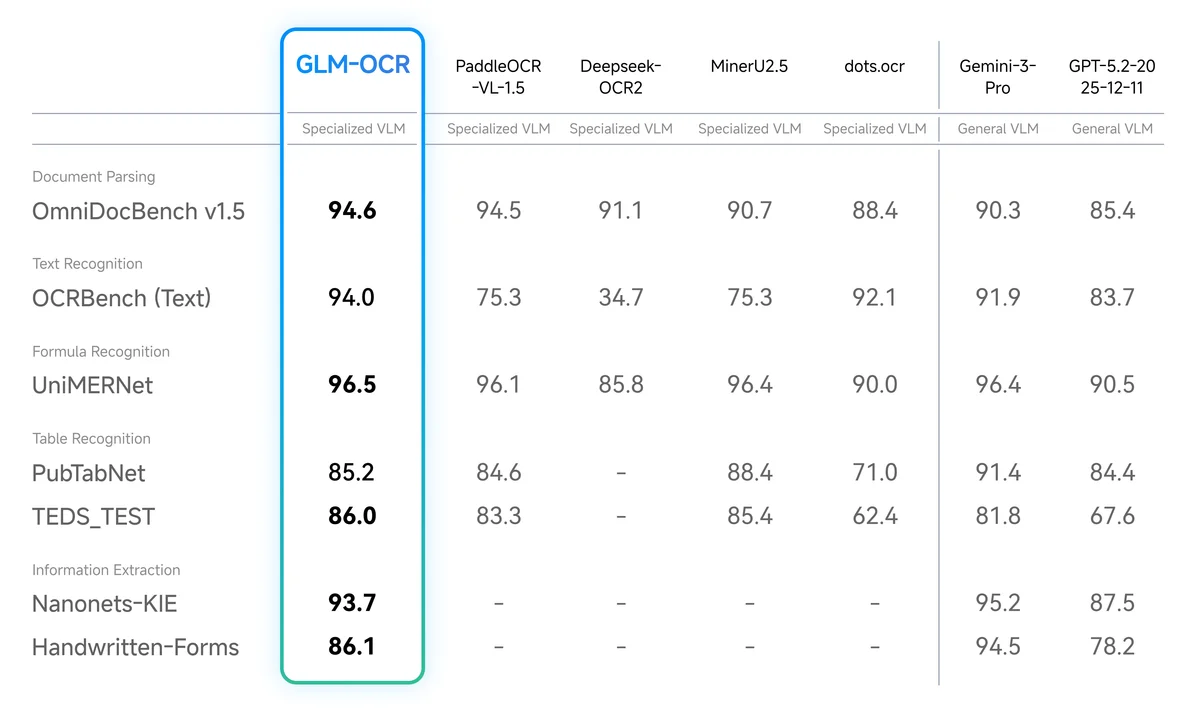
OmniDocBench v1.5 (Overall) (score, higher is better)
OmniDocBench v1.6 (Overall) (score, higher is better)
Real5-OmniDocBench (Overall) (score, higher is better)
OCRBench (Text) (score)
UniMERNet (formula recognition) (score)
Throughput, PDF parsing (pages per second (single replica, single concurrency))
Where this comes from
Limitations
- Two-stage errors: mistakes in the layout step carry through, and reading order can suffer on cross-page or irregular multi-column layouts (technical report).
- Weaker on very low-resolution or distorted pages, complex math, dense or irregular tables, and under-represented languages; line breaks and whitespace can vary between runs (technical report).
- An independent tutorial found weak results on a table with merged rows and unclear column boundaries, errors on complex or very small formulas, and layout sometimes ignored in text mode (Debugger Cafe).
- An independent review read a multilingual score of 69.3 and an old-scans score of 37.6 percent in the report's figures, and judged vertical and CJK text a likely weak point (lilting.ch); these numbers come from the reviewer, not from a page read directly.
Further Reading
- GLM-OCR Technical Report arXiv (Z.ai authors), 11 Mar 2026
- GLM-OCR (API guide) Z.ai documentation
- PaddleOCR-VL-1.6: Expanding the Frontier of Document Parsing with Under-Optimized Region Refinement and Progressive Post-Training arXiv (PaddleOCR-VL-1.6 authors), 2 Jun 2026
- Getting Started with GLM-OCR Debugger Cafe (Sovit Ranjan Rath), 24 Aug 2026
- GLM-OCR (0.9B) sets a new SOTA for document parsing, so I checked columns, vertical text, and math support lilting.ch (Ikesan), 17 Mar 2026
Sources
- huggingface.co/zai-org/GLM-OCR https://huggingface.co/zai-org/GLM-OCR
- huggingface.co/zai-org/GLM-OCR/tree/main https://huggingface.co/zai-org/GLM-OCR/tree/main
- github.com/zai-org/GLM-OCR https://github.com/zai-org/GLM-OCR
- github.com/zai-org/GLM-OCR/blob/main/LICENSE https://github.com/zai-org/GLM-OCR/blob/main/LICENSE
- GLM-OCR Technical Report arxiv.org https://arxiv.org/abs/2603.10910
- arxiv.org/html/2603.10910 https://arxiv.org/html/2603.10910
- arxiv.org/html/2603.10910v2 https://arxiv.org/html/2603.10910v2
- arxiv.org/abs/2606.03264 https://arxiv.org/abs/2606.03264
- arxiv.org/html/2606.03264v1 https://arxiv.org/html/2606.03264v1
- docs.z.ai/guides/vlm/glm-ocr https://docs.z.ai/guides/vlm/glm-ocr
- debuggercafe.com/getting-started-with-glm-ocr https://debuggercafe.com/getting-started-with-glm-ocr/
- lilting.ch/en/articles/glm-ocr-document-parsing-layout https://lilting.ch/en/articles/glm-ocr-document-parsing-layout
- opensource.org/license/mit https://opensource.org/license/mit
To cite this page: Project AURION, AI Use-Cases Research & Innovation, "GLM-OCR", https://aurion.semai.id/top-10/zhipu-zai-glm-ocr/, records of November 2026.